How to Enchant in Minecraft
Here is how to enchant in Minecraft. There are four ways to get enchantments: the enchanting table, books on an anvil, librarian villagers and loot. This guide covers each one, in the order most players use them.
1. The enchanting table
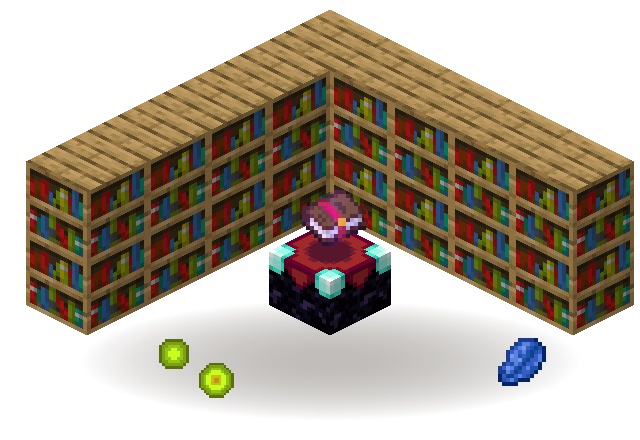
Craft an enchanting table and surround it with 15 bookshelves. Put an item and lapis lazuli in it: you get three random options, costing 1, 2 or 3 lapis and levels. With 15 bookshelves the bottom option is always level 30.
The table only gives non-treasure enchantments, and it picks them at random. The table calculator shows your odds. Gold gear gets the best results; diamond the worst of the late-game materials.
2. Books on an anvil
An anvil moves enchantments from books onto gear and merges two books of the same level into the next level. Every use raises the prior work penalty, so the order matters: the enchantment calculator finds the cheapest one and avoids Too Expensive!
3. Librarian villagers
Librarians sell enchanted books for emeralds, including Mending. Reroll them until they offer what you need. See the price list and the trading hall guide.
4. Loot and treasure
Some enchantments never come from the table: Curse of Binding, Curse of Vanishing, Frost Walker, Mending, Soul Speed, Swift Sneak, Wind Burst. You find them in chests, by fishing, from piglins or in trial chamber vaults. See treasure enchantments.
5. Removing enchantments
A grindstone removes every enchantment except curses and gives back some experience.
6. What to aim for
See the best enchantments for every item, or go straight to god armor, the best sword or the best pickaxe.
A plan from first table to god gear
Early on, enchant iron gear at a small table: even level 10 to 15 options give useful Protection, Efficiency and Unbreaking. Once you have diamonds, build the full table with 15 bookshelves and save your levels for level 30 enchants. At the same time, set up two or three librarians, because they turn emeralds into exact books.
When the books are ready, look up your item on the best enchantments pages and follow the cheapest anvil order: sword, pickaxe, chestplate, boots, mace and bow. Finally, upgrade the enchanted diamond gear to netherite at a smithing table; the enchantments carry over.
How the table picks your three options
Each option has a level number. The table rolls it from the number of bookshelves, and the bottom option is never lower than twice the shelf count. That is why 15 shelves always give a level 30 bottom slot, while the top and middle slots still vary.
| Bookshelves | Top option | Middle option | Bottom option |
|---|---|---|---|
| 0 | 1–2 | 2–6 | 3–8 |
| 2 | 1–3 | 2–8 | 4–11 |
| 4 | 1–4 | 3–10 | 8–14 |
| 6 | 1–5 | 3–12 | 12–17 |
| 8 | 1–6 | 4–14 | 16–20 |
| 10 | 2–7 | 5–16 | 20–23 |
| 12 | 2–8 | 5–18 | 24–26 |
| 15 | 2–10 | 6–21 | 30 |
With no shelves at all, the best you can see is level 8. With 15, the middle slot ranges from 6 to 21 and the top from 2 to 10. More than 15 shelves does nothing, so stop there.
What happens after you click
The level on the button is not the final strength. First, the game adds a bonus from the item's enchantability, then it nudges the result up or down by as much as 15%. That modified level decides which enchantments and which levels can appear.
Next, the game picks one enchantment from the list that fits, weighted by rarity. Common ones like Protection, Sharpness and Efficiency show up far more often than Silk Touch or Thorns. After that, it may add more enchantments. The chance of each extra one is about the modified level divided by 50, and the level halves after every extra pick. So a level 30 roll often gives two enchantments, sometimes three, and rarely four.
Books are different. If a book rolls more than one enchantment, the game removes one at random. That is why books usually come out with a single enchantment: at level 30, only about 21% of books get two or more, against roughly 69% for a diamond pickaxe.
Why the material matters
Enchantability is a hidden number on every enchantable item. Higher enchantability pushes the modified level up, so you get stronger and more numerous enchantments for the same 30 levels. Here is how the materials compare at a full level 30 table.
| Material | Tool enchantability | Armor enchantability | Best Efficiency at 30 | Best Sharpness at 30 | Chance of Efficiency V |
|---|---|---|---|---|---|
| Wood | 15 | – | V | IV | 0.5% |
| Stone | 5 | – | IV | IV | never |
| Copper | 13 | 8 | V | IV | 0.5% |
| Iron | 14 | 9 | V | IV | 0.5% |
| Gold | 22 | 25 | V | V | 7.7% |
| Diamond | 10 | 10 | IV | IV | never |
| Netherite | 15 | 15 | V | IV | 0.5% |
Two things stand out. First, diamond tools have the lowest enchantability of any tier except stone, so a diamond pickaxe can never roll Efficiency V at the table, and a diamond sword tops out at Sharpness IV. Second, netherite has much better enchantability than diamond. If you plan to table-enchant, upgrade the blank diamond item to netherite at a smithing table first, then enchant it. If you plan to use books, the order does not matter, because enchantments carry over through the upgrade.
Gold rolls the best results of all, but gold gear breaks very quickly. Still, a golden tool is handy for a short task, and it is cheap practice for learning how the table behaves.
Items the table can't help with
Some items have zero enchantability, so the table refuses them completely: elytra, shears, brush, flint and steel, shield, carrot on a stick, warped fungus on a stick. You enchant all of these with books on an anvil. The trident, bow, crossbow and fishing rod have the minimum enchantability of 1. The table accepts them, but the results are weak, so a bow can reach Power IV at best. For these items, books and librarians are the better plan.
Books also have an enchantability of 1. At level 30 a book can reach Protection IV, Efficiency IV or Sharpness IV. Efficiency and Sharpness stop one level short of the top. Two matching books merge into the next level on the anvil, so a pair of Sharpness IV books makes Sharpness V.
Building the bookshelf ring
The easiest layout is a 5×5 square with the table in the middle. Put bookshelves on the outer edge of that square, one block high, which gives 16 spots. Fill 15 of them and leave the last one open as a doorway. That is the classic setup, and it fits inside a small room.
In Java, the gap can contain air or replaceable blocks such as short grass, snow layers or water. Torches, carpets and slabs block bookshelf power. An air gap is the simplest layout.
- Compact build: stack the shelves two high on three sides of the 5×5 ring and leave the fourth side open. You only need 15, so the second layer can have a gap.
- Controlled levels: if you want low-level options on purpose, break a few shelves or block their gap. Lower levels make some enchantments more likely, and the table calculator shows exactly which level gives your target most often.
- Plan it first: the bookshelf setup tool lets you place shelves on a grid and counts the power for you.
- Get the materials: 15 shelves take 45 books, which is 135 paper and 45 leather. A sugar cane farm and a few cows cover it. See the bookshelf page for the recipe.
Spending your levels wisely
Experience gets more expensive per level the higher you go. Level 30 takes 1395 experience points from zero, but level 15 only takes 315. The enchanting table only removes 1, 2 or 3 levels, so the top option costs you the points between level 27 and 30, which is 306 points.
That leads to a simple routine. Get to level 30, enchant once, then earn just three levels back and enchant again. You never need to bank 60 or 100 levels for the table, because the extra levels are not used.
The anvil works the other way. It charges the full cost in levels, and every level you take from a high level is worth more points. For example, a 20-level anvil step costs 550 points if you are at level 20, but 2370 points if you are at level 40. So do your anvil work as soon as you have enough levels for it, not after a long grind. The XP calculator works out these numbers for any level.
Getting new options
The three options stay the same until you enchant something. Swapping items or leaving the table does not reroll them. To see a fresh set, spend the cheap top option on a book or a spare tool. It costs 1 lapis and 1 level, and the next item you put in gets brand-new offers.
Table, anvil or villager: which to use
Each source has a job. Mixing them is how most players reach max gear without wasting levels or emeralds.
| Source | You choose the enchantment? | Treasure enchantments? | Main cost | Best for |
|---|---|---|---|---|
| Enchanting table | No, random | Never | Levels and lapis | Early gear and cheap filler books |
| Anvil with books | Yes | Yes, if you have the book | Levels | Finishing max gear |
| Librarians | Yes, after rerolling | Mending, Frost Walker and curses | Emeralds and books | Exact top-level books |
| Loot and fishing | No | Yes | Time | Rare treasure books |
Early in the game, the table wins because you have no villagers yet. In the mid game, librarians take over for the books you want most. Late in the game, the anvil does most of the work, and the table just turns spare levels into books you can merge or sell.
Common enchanting mistakes
- Putting the best item in first. Test what the table offers with a book or a cheap item, then decide. Remember the offers depend on the item, so check again with the real one.
- Enchanting diamond tools at the table. Diamond tools have worse enchantability than iron, gold or netherite. Upgrade to netherite first, or use books.
- Adding books one by one. Each anvil use raises the next cost. Merge books into pairs first, or follow the calculator, so you never hit Too Expensive!
- Mixing exclusive enchantments. Sharpness, Smite and Bane of Arthropods exclude each other, as do the four Protection types. Check the conflict list before you buy books.
- Renaming as a separate step. A rename on its own costs 1 level plus the item's whole penalty. Rename during your last book step instead, for just 1 extra level.
- Throwing away junk enchants. A grindstone turns unwanted enchanted items back into experience, and the cleaned item can go through the table again.
Where to go next
Once you know the basics, pick an item and go straight to its build. The sword, pickaxe and armor pages list the max enchantments, and each enchant order page shows the cheapest anvil steps. For the rarest books, read the treasure enchantments guide and how to get Mending. To see what each level actually does, the sword damage calculator and armor protection calculator help.
Early game: enchanting with few levels
You don't need a full table to start. Even a handful of shelves helps, and iron tools have better enchantability than diamond tools. Here is the best an iron pickaxe and an iron chestplate can roll at each level.
| Option level | Iron pickaxe Efficiency | Iron pickaxe Unbreaking | Iron pickaxe Fortune | Iron chestplate Protection |
|---|---|---|---|---|
| 8 | Efficiency II | Unbreaking II | Fortune I | Protection II |
| 15 | Efficiency III | Unbreaking III | Fortune II | Protection III |
| 20 | Efficiency IV | Unbreaking III | Fortune II | Protection III |
| 25 | Efficiency IV | Unbreaking III | Fortune III | Protection IV |
| 30 | Efficiency V | Unbreaking III | Fortune III | Protection IV |
These are the best possible results, not the usual ones. Still, the pattern is clear. Unbreaking III is already in reach at level 15, and Efficiency IV at level 20. So a cheap 8 to 10 shelf setup with iron gear carries you through the early game. Then, once you have diamonds, switch to books and librarians.
A good first goal is an iron pickaxe with Efficiency and Unbreaking. It mines faster, lasts much longer, and pays for the rest of your enchanting through the ores it digs up.
What a level 30 roll really gives
The table is random, so it helps to know the odds. These numbers come from the same table maths the site's calculator uses, run thousands of times.
- Diamond pickaxe at level 30: Efficiency shows up about 81% of the time, nearly always as level IV. Unbreaking appears about 62% of the time, Fortune about 32% and Silk Touch about 17%.
- Diamond chestplate at level 30: Protection appears about 53% of the time, and Protection IV about 22%. Unbreaking is the most common pick at about 68%.
- Two or more enchantments: about 68% of level 30 rolls on diamond gear give at least two.
So the table is good at giving you a solid base with Unbreaking and a decent main enchantment. However, it is bad at giving one exact result, like Fortune III and Efficiency V together. That is the point where books take over. Use the table calculator to see these odds for any item and level.
Lapis lazuli and how much you need
Every option costs lapis: 1 for the top slot, 2 for the middle and 3 for the bottom. So a stack of 64 lapis covers 21 level 30 enchants. Lapis ore drops several pieces per block, and Fortune multiplies that, so one good cave trip usually covers a long enchanting session.
Lapis ore is most common deep underground. Mine it with a Fortune pickaxe if you have one. If you plan to enchant a lot of books for merging, keep a few stacks ready, because books go through lapis quickly.
A full plan for one item
Here is how a typical diamond pickaxe goes from blank to max, using all four sources.
- Step 1: enchant a book or two at level 30 while you mine. Keep any Unbreaking III or Fortune books.
- Step 2: buy Mending and Efficiency V from your librarians, because the table can't give either on diamond.
- Step 3: open the pickaxe enchant order and follow it step by step. The full build costs 23 levels in total.
- Step 4: upgrade it to netherite at a smithing table when you can. The enchantments stay.
The same plan works for every item. Swap in the books from that item's best enchantments page, and check Fortune vs Silk Touch if you are unsure which pickaxe to build first.
Using the table as a book factory
Late in the game, many players stop enchanting gear at the table. Instead, they enchant stacks of books at level 30 and merge the useful ones. Books can roll every table enchantment, so nothing is off limits.
The catch is the spread. With so many possible enchantments, each one is rare on its own. In the site's simulation, a level 30 book comes out with Protection about 9.3% of the time, and Efficiency about 9.3%. Protection III is the most common Protection result at about 8.3%. So for a specific book, a librarian is faster. For a pile of mixed books to merge and keep, the table is cheap.
Keep your rolls sorted in chests by enchantment. Once you have two of the same book and level, merge them, and you slowly work your way up to the max levels for free.
Not every roll is worth keeping. Books with weak or unwanted enchantments, like low Bane of Arthropods or Punch I, can go through a grindstone. You get back a plain book and a little experience, and the book goes straight back into the table for another try.
Questions
What do you need to enchant in Minecraft?
An enchanting table, lapis lazuli and experience levels. For the best options, 15 bookshelves around the table.
Why are my enchanting options grey?
You don't have enough levels or lapis lazuli, or the item can't be enchanted at a table (like an elytra or a shield).
How do you get Mending?
Not from the table. See the guide on how to get Mending: librarians are the easiest way.
Why does my enchanting table only go up to level 8?
It has no working bookshelves. Without shelves the bottom option tops out at level 8. Place 15 bookshelves two blocks from the table with nothing in between to reach level 30.
Is it better to enchant books or gear at the table?
Gear gets more enchantments per roll, so it is better when the result fits your plan. Books usually get one enchantment, but you choose later which item gets it.
Can you enchant netherite gear at an enchanting table?
Yes. Netherite also has better enchantability than diamond, so upgrading a blank diamond item first and then enchanting it gives better results.
Why can't I get Efficiency V from the enchanting table?
A diamond pickaxe can't roll it because of its low enchantability. Netherite and gold can, but rarely. The reliable way is to merge two Efficiency IV books or buy Efficiency V from a librarian.
How many levels do you need to enchant at level 30?
You need to be at level 30 or higher to pick the option, but it only takes 3 levels and 3 lapis lazuli.